Don't miss our holiday offer - up to 50% OFF!
Learning Through Play: Why Children Learn Best When They’re Having Fun
Why play-based learning works, what children actually learn through different kinds of play, and how Indian parents can use play to build maths, language and thinking skills.

“Stop playing and study!” is something most of us heard as children — and many of us say it now. But for young children, playing is studying. It’s how they learn maths, language, science, social skills and self-control. This post explains why play-based learning works and how to make the most of it at home.
What “learning through play” really means
Play-based learning doesn’t mean leaving children alone with toys and hoping for the best. It means children learn by actively doing — exploring, experimenting, imagining and solving problems — usually because they want to, with adults supporting rather than directing.
India’s National Education Policy 2020 and the National Curriculum Framework for the Foundational Stage put play and activity at the centre of learning for ages 3–8. Teachers and researchers around the world have long observed the same thing: young children learn most deeply when they are engaged, active and enjoying themselves.
Why play works so well
- Motivation is built in. Children play because they want to, so attention and effort come naturally.
- It’s hands-on. Young children understand abstract ideas best through concrete experience — holding three blocks before writing “3”.
- Mistakes are safe. A tower that falls isn’t a failure; it’s information. Play builds resilience.
- It’s repeated willingly. Children repeat play activities dozens of times, which is exactly how skills become strong.
- It’s social. Playing with others builds language, negotiation, empathy and patience.
What children learn from different kinds of play
Building and construction play
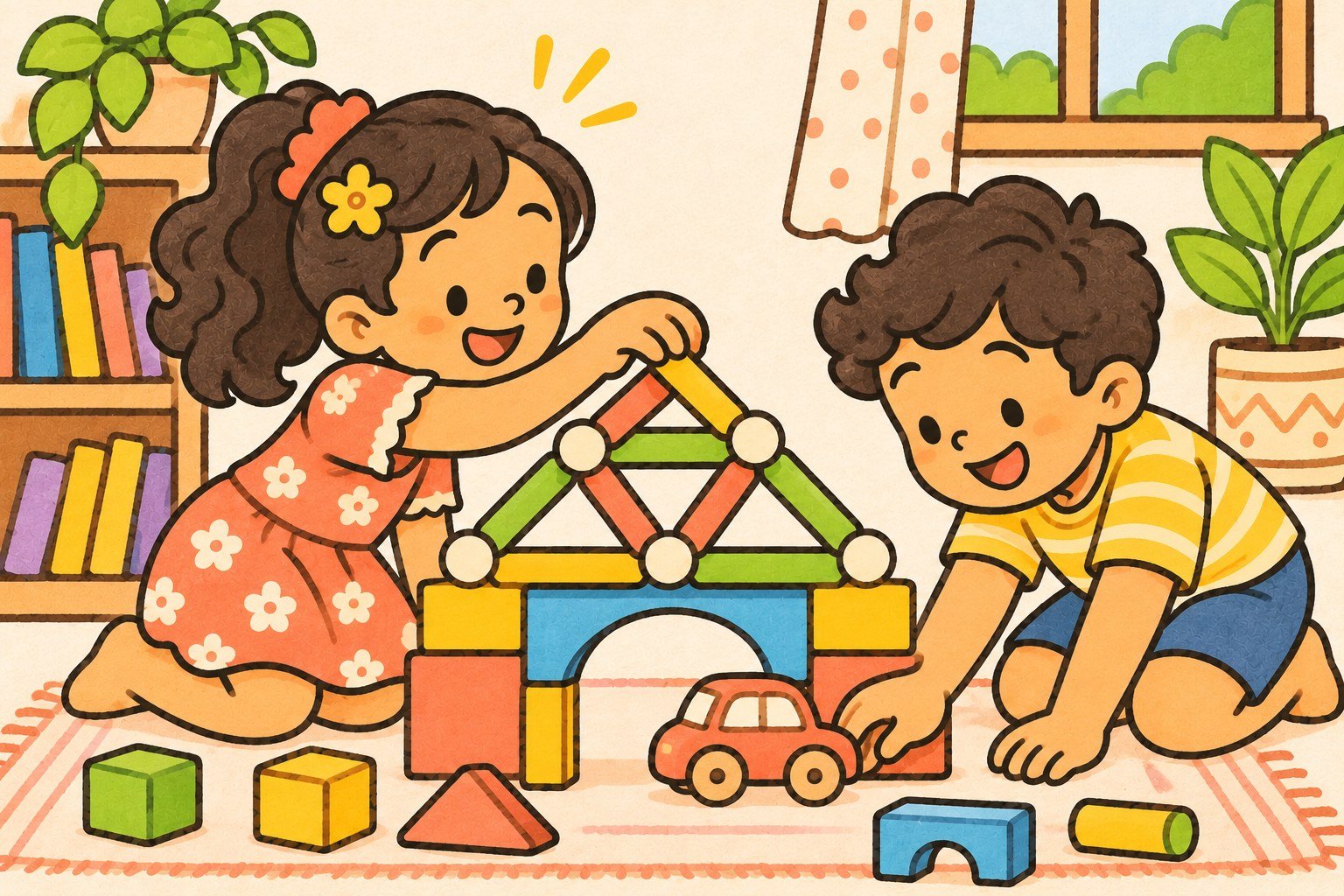
Blocks, magnetic tiles and sticks teach spatial reasoning, early geometry, balance, planning and problem-solving. Children learn that a wide base holds a taller tower and that triangles make strong structures. Try magnetic sticks (3+) or the My Blocks 87-piece set (4–6 years). More on this in why building and STEM toys matter.
Puzzles
Puzzles develop visual discrimination, shape recognition, fine motor control and persistence. Wooden inset boards like our numbers & maths symbols board (4–6 years) also introduce numbers and symbols in a hands-on way. See our puzzle buying guide by age.
Pretend play
Playing doctor, shopkeeper, cook or teacher builds vocabulary, storytelling, empathy and understanding of how the world works. A pretend doctor’s kit turns into lessons on the body, caring and taking turns.
Music and rhythm play
Songs, rhymes and simple instruments support language, memory, counting and pattern recognition. A small xylophone (3+) lets children explore high and low, loud and soft, and simple sequences.
Art and craft
Drawing, colouring and crafts build fine motor skills for writing, plus creativity and planning. A magnetic drawing board (3+) is a mess-free option for travel and quiet time.
Movement and active play
Running, jumping, climbing and throwing build coordination, strength and body awareness — and help children concentrate better afterwards. Indoor options like an inflatable bop bag help burn energy on rainy days.
Games with rules
Board games, card games and stacking games teach turn-taking, counting, strategy and handling winning and losing gracefully. A tumbling tower (6–9 years) is a family favourite.
How parents can support play-based learning
Set the stage, then step back
Put out interesting materials and let your child lead. Resist the urge to show them the “right” way to build or play.
Talk about what they’re doing
“You used all the red blocks on the bottom — why?” Describing and asking open questions builds language and thinking without taking over.
Add a gentle challenge
“Can you build a bridge a car can drive under?” “Can you find all the shapes with three sides?” Small challenges stretch skills while keeping it fun.
Choose open-ended toys
Toys that can be used many ways — blocks, puzzles, art supplies, pretend play sets — grow with the child. Toys that do one thing at the press of a button are fun for a day but teach less.
Keep fewer toys out at once
A small, rotating selection leads to deeper play than an overflowing toy box.
Protect play time
Classes, homework and screens can squeeze play out of a child’s day. Treat play as essential, not optional.
“But will they be ready for school?”
This is the biggest worry Indian parents have. Play doesn’t replace learning letters and numbers — it’s the best way to learn them for young children. A child who has spent years building, counting, talking, pretending and solving problems arrives at formal learning with strong foundations: attention, language, number sense, motor skills and confidence.
The bottom line
Children learn best when they’re having fun because fun means engaged, curious and willing to try again. Give your child time, a few good open-ended toys, and an interested adult — and play will do more for their education than any worksheet.
Browse toys by age in our educational toys by age guide.