Don't miss our holiday offer - up to 50% OFF!
Magnetic Toys for Kids in India: What’s Safe, and What to Buy
Two different toys share the word magnetic. One is fine from three, the other is a risk. How to tell them apart, and the three sets we stock.

Magnetic toys for kids come in two completely different kinds, and the difference matters more than the word.
One is a sealed stick or tile with the magnet moulded inside, too big to swallow. The other is a set of small loose magnets that come apart in a child’s hand.
From a listing photo they look the same: bright pieces in a box, the word magnetic on the front. Only one is a toy we would put in front of a four-year-old.
The short answer
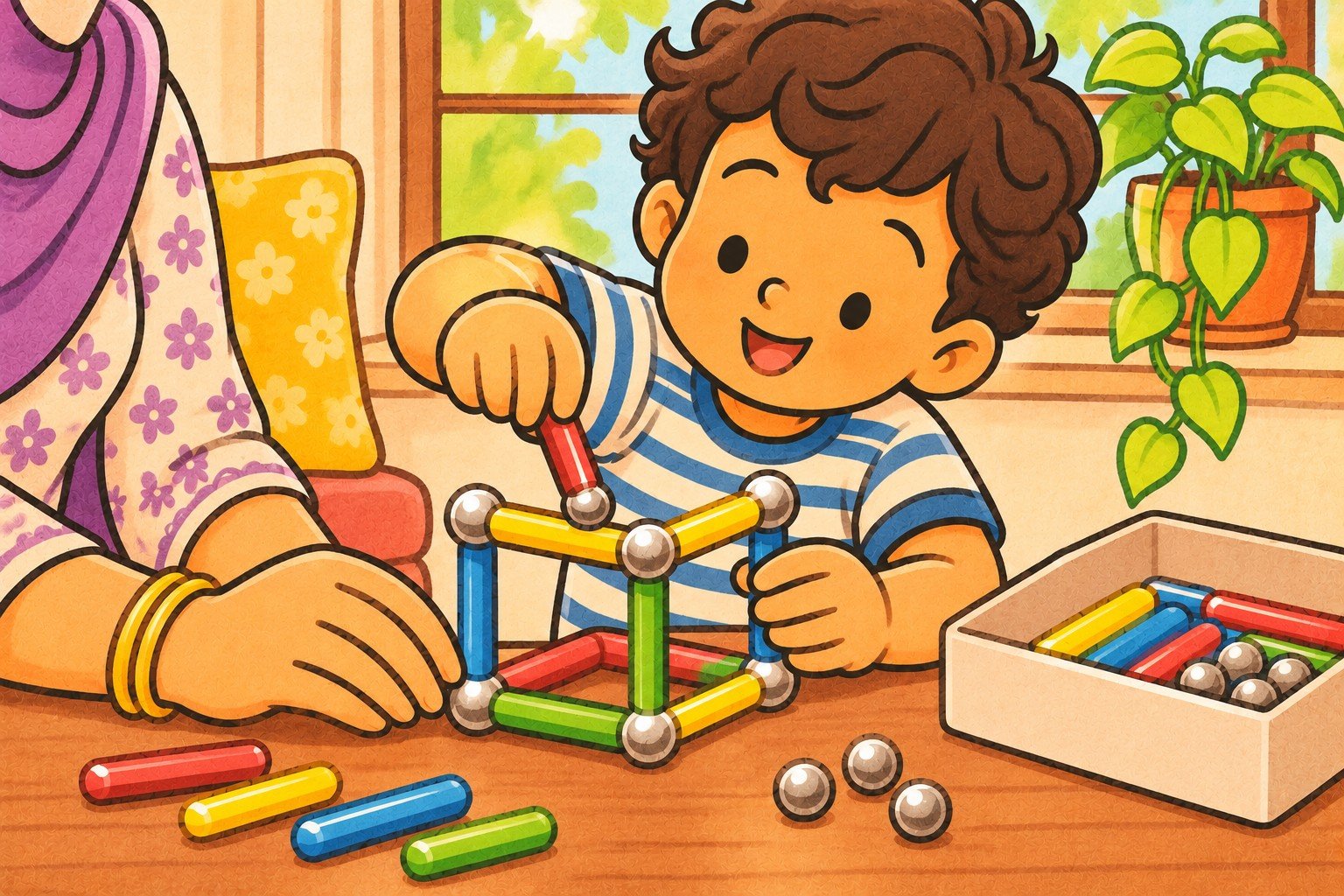
For most families a magnetic stick set is fine from about three, provided the magnets are sealed inside the pieces and your child has finished mouthing things. Our 25-piece set at ₹489 is the one we would start with. The 36-piece at ₹659 is the same toy with enough pieces to build something that stands up. If your child is six or over, the 42-piece at ₹749 is the one that stops feeling small. Under three, buy none of them.
Magnetic toys for kids in India: the two kinds
Sealed magnets live inside a piece of the toy. In a magnetic stick set the magnets are moulded into the sticks and balls, so you cannot reach one without breaking the piece.
The second kind is a loose small magnet. The balls sold as desk toys, the tins of magnet cubes, the discs that fall out of a cheap figure. These turn up in a toy box after a birthday party, without the box and often without an age mark.
We sell the first kind and not the second.
Why small magnets are the risk
One magnet on its own is not much of a problem. Two are.
If a child swallows two small magnets, or one magnet and a piece of metal, they can pull towards each other through the tissue between them. Whatever is caught in the middle is pinched, and that is the injury. They do not need to be large: only small enough to swallow and strong enough to find each other.
We do not quote scare numbers here, because the number that matters is one. If you think a magnet has been swallowed, call your doctor or take your child to hospital, and do not wait for a symptom.
What “enclosed” actually means
Enclosed does not mean hidden. It means the magnet cannot come loose during ordinary play.
In a magnetic stick set the magnets sit inside the sticks and connector balls, so there is nothing small and bare lying around to swallow. That is the design we look for, and why these sets are rated for three and up rather than eighteen months.
The failure point is at the ends. If a stick cracks or a seam opens, the magnet inside becomes a loose magnet. Run a thumb over the ends now and then, and bin any piece that is cracked or showing the magnet.
What a three, four and six-year-old can do
At three
A three-year-old builds flat things. A line, a triangle, a square, then a triangle balanced on the square. The joints rotate a full 360 degrees, so turning a stick around and feeling the magnet push back is an activity in itself.
Plan on sitting with them for the first few sessions. Three is when mouthing is mostly finished but not reliably finished, so if your child still chews things, this is not the toy yet.
At four
Four is where flat becomes solid. A cube, a pyramid, a house with a roof. The child starts planning two steps ahead, and the set stops being a pile of pieces and becomes a way to make something.
This is the age the 25-piece set earns its money. The 36-piece suits a house that already has a builder.
At six
By six, a child works from a picture, builds something big enough to leave out overnight, and rebuilds it in the morning. That is what the 42-piece set is for.
It is not a different toy. Same sticks, same joints, more ambition, and no adult sitting there.
If you are choosing by age more broadly, our age-by-age guide to educational toys covers what each stage is actually ready for.
A safety checklist before you buy any magnetic set
The age mark. 3 and up means something specific. No age mark at all, put it back.
The ISI mark. Where a toy is in scope of compulsory certification, the box carries the ISI mark and a licence number, issued through the Bureau of Indian Standards scheme and never by the shop. Our guide to checking the BIS mark shows how to verify it.
The ends of every stick. A visible seam, a cap that moves, a rattle when you shake it. Any of those means the magnet is not properly sealed.
Piece size. Anything that fits whole into a small child’s mouth is a small part, whatever the box says.
What you will do when a piece breaks. If the honest answer is not “throw it out”, buy a different set.
What to buy
| Set | Pieces | Price | Age on the box | Best for |
|---|---|---|---|---|
| Magnetic Sticks Puzzle — 25-Piece STEM Building Set | 25 | ₹489 | 3 and up | A first set, flat shapes |
| Magnetic Sticks Puzzle — 36-Piece STEM Building Set | 36 | ₹659 | 3 and up | Pyramids and cubes that stand up |
| Magnetic Sticks Puzzle — 42-Piece STEM Building Set | 42 | ₹749 | 3 and up | Bigger structures and independent play, best at 6–9 |
| My Blocks — 87-Piece Building Block Set | 87 | ₹449 | 4–6 | A child who wants volume, not magnets |
The 25-piece set is the right first set for most three and four-year-olds: every flat shape, a few simple solids, and small enough to tidy away in one go. The 36-piece is where a pyramid actually holds, so it suits a house that already has a builder. The 42-piece is for the child who has used magnetic sticks before and wants a build to last the evening.
If what the child really wants is a large pile to build a wall and knock down, the 87-piece block set at ₹449 is cheaper than any magnetic set and has no magnets in it. That is not a compromise, just a different toy.
What to skip
Loose magnetic balls, magnetic putty and the tins of magnet cubes sold as desk toys. They are bought for adults, they end up in the toy box, and they are the size that gets swallowed.
A magnetic set with no box and no age mark, often a party gift. Thank the giver and put it out of reach.
Hundred-piece magnetic tile sets for a three-year-old. Too many pieces to manage, and the first thing that happens is a missing piece.
Thin sticks where you can see the magnet at the tip. If you can see it, it can come out.
Fridge magnet letters for a child under three, for the same reason.
Quick questions
Are magnetic tiles safe for a three-year-old?
Usually, yes. Tiles are sealed and chunky, and the same rules apply: sealed magnet, no cracks, an age mark on the box, no loose magnetic pieces. A cracked tile is a loose magnet, and that is the problem.
What happens if a child swallows a magnet?
Two magnets, or a magnet and something metal, can pull together through the wall of the bowel and pinch the tissue between them. Symptoms are not always obvious, so do not wait. If you think one was swallowed, call your doctor or go to hospital.
Are magnetic toys safe for a two-year-old?
No. Two-year-olds put everything in the mouth, the pieces are small parts, and every magnetic set we sell is rated 3 and up. They can hand pieces to an older sibling, but should not have the set to themselves.
Do the magnets lose their strength over time?
Not in a way you will notice in normal play. What changes is the piece itself: a stick dropped on tile many times can crack, and that is when the magnet is exposed. Check the pieces, not the strength.
How many pieces should we start with?
Twenty-five for a first set. Thirty-six if your child already builds with blocks and you want the first pyramid to hold. Forty-two if they are six or older. If you cannot decide, buy the smaller one; the larger set is easy to add later.
If you know the age and the budget, the building toys shelf is where the magnetic sets live, and the STEM toys shelf has the rest. Every order also gives 2% to a child in need.
Related reading
Why building and STEM toys matter: what open-ended building actually gives a child.
How to check the BIS mark on a toy box: where the ISI mark sits, and what it does not cover.
Wooden vs plastic toys: where wood earns its price, and where plastic is the better buy.
Prices were checked on 2 November 2026.