Don't miss our holiday offer - up to 50% OFF!
Screen Time and Kids: What the Latest Guidelines Actually Say

If you’ve felt confused about screen time rules for children, you’re not imagining it — the guidance itself has changed. For years, parents were told to stick to strict numbers: no screens before 18 months, one hour a day for ages 2–5. Those numbers came from the American Academy of Pediatrics (AAP) and were echoed by the World Health Organization.
In 2026, the AAP updated its approach. Instead of a fixed hourly limit for every child, the new guidance focuses on the quality and context of screen use — asking whether it’s replacing sleep, movement, and real-world play, rather than just counting minutes.
Here’s what stayed the same, and what’s genuinely useful for parents trying to make sense of it.
What Hasn’t Changed
A few things remain consistent across both the older and newer guidance:
Under 18 months: Screens are still not recommended, except for video-calling family. Ages 2–5: Around one hour a day of high-quality, co-viewed content is still a reasonable benchmark — not a hard ceiling, but a useful anchor. Unstructured, hands-on play is still considered more valuable for a young child’s brain than passive screen time, at any age. This part hasn’t moved at all. What’s Different Now
The 2026 update shifts the conversation away from “how many hours” and toward “what is this replacing?” A pediatrician today is less likely to ask how many minutes your child spent on a tablet, and more likely to ask: Is your child still sleeping well? Still playing and moving? Still having real conversations? If screen use is crowding those things out, that’s the actual signal to dial it back — regardless of the exact number on the clock.
That’s a more useful question for most families anyway, because it adapts to real life instead of a one-size-fits-all number.
So What Do You Actually Do With the Time?
This is usually where parents get stuck. Knowing you want less screen time is one thing; filling that time with something a child will actually enjoy is another. A few things that reliably work:
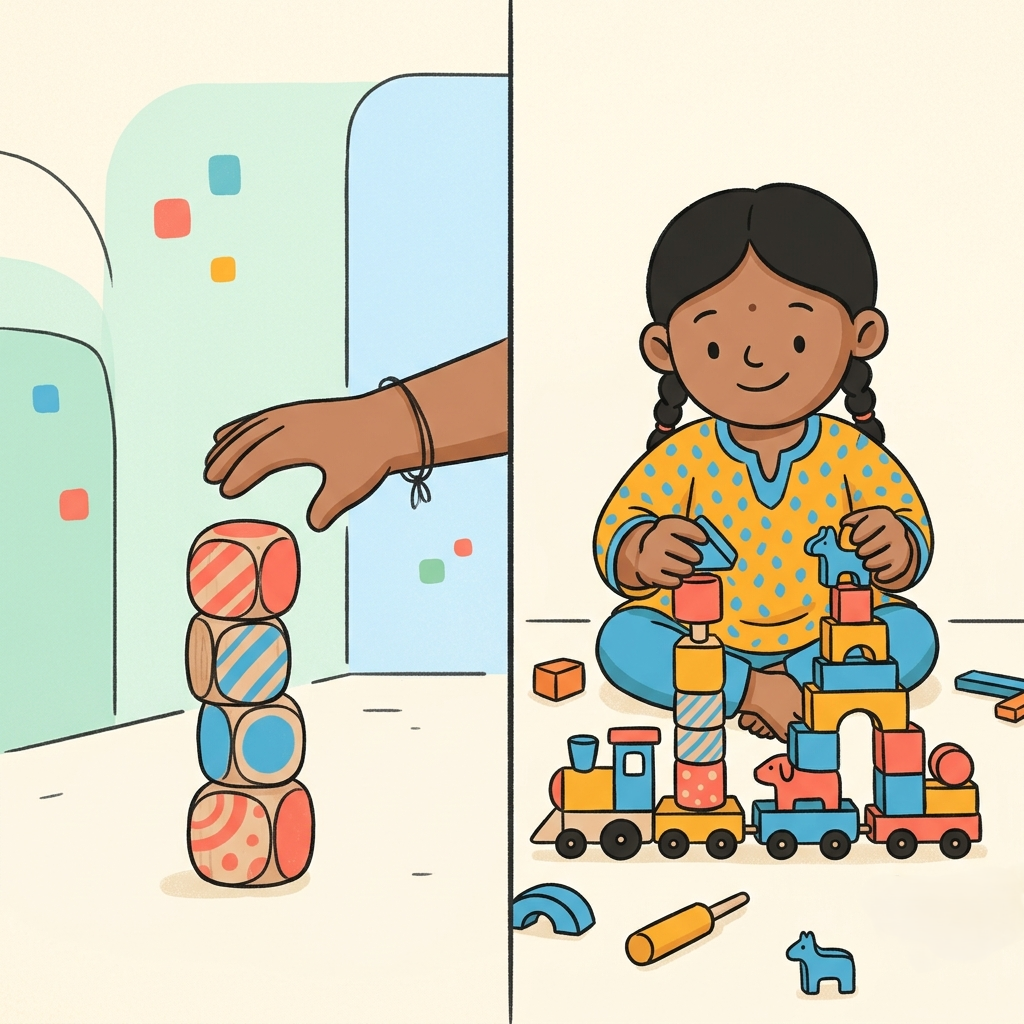
Give the child’s hands a job. Building sets, puzzles, and construction toys work because they’re open-ended — there’s no “finishing” a good set of blocks, so a child can return to it for 20 minutes or an hour depending on their mood.
What to put in the screen’s place
The honest difficulty with screen time guidance is that it tells you what to remove without telling you what to replace it with. Everything at Tukoy is screen-free by design — browse by age from 1-3 years through 3-6 to 6-9 years, or see everything under ₹500.
[…] or not anyone is watching. If you want the evidence rather than the argument, we went through what the current screen time guidelines actually say […]