Don't miss our holiday offer - up to 50% OFF!
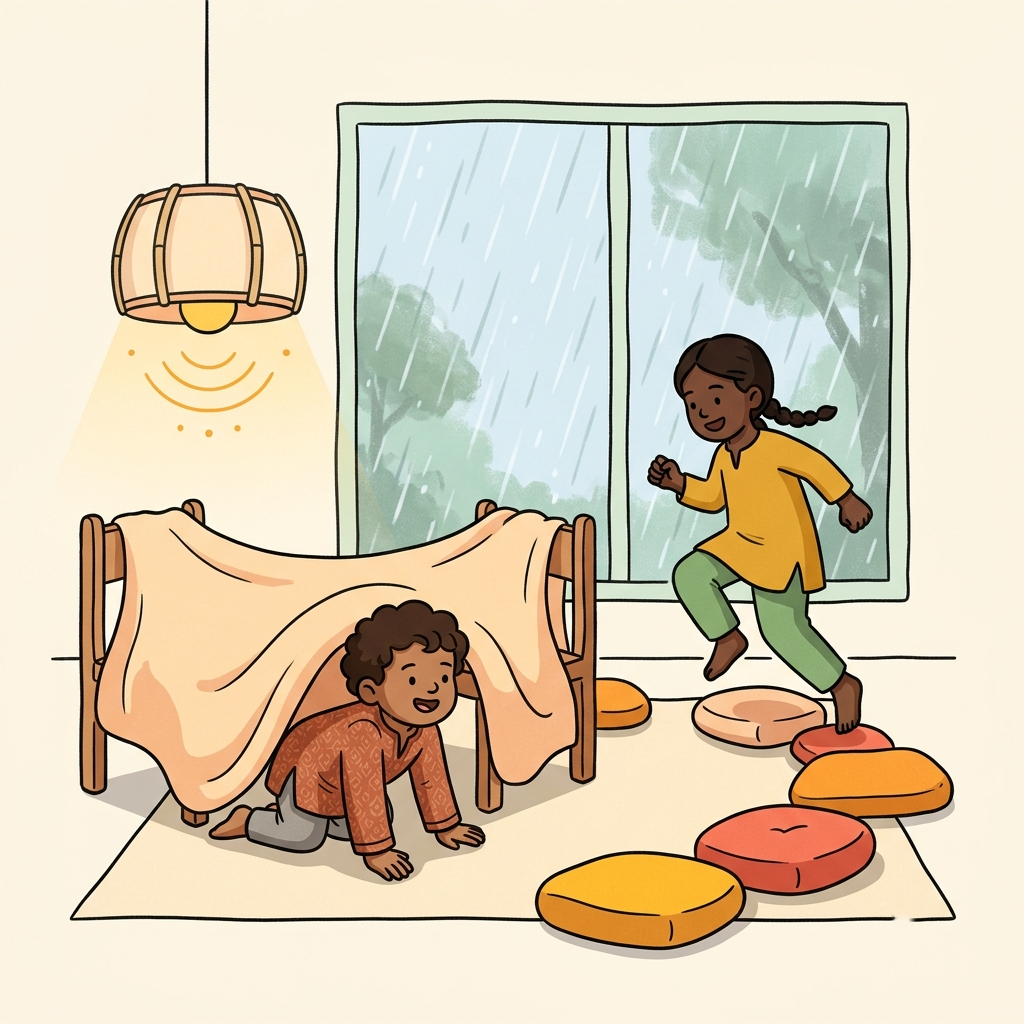
Indoor Games for Kids on a Rainy Day (Ages 3–9)
Fourteen indoor games sorted by what they actually do for you — burn energy, keep two children busy, or bring the room down again — for a monsoon week at home.

The hard part about a wet week is not boredom. It is that a six year old produces roughly the same amount of energy on a rainy Tuesday as on a dry one, and none of it gets spent. By evening the house has absorbed all of it.
So these are sorted by what they actually do for you: the ones that burn energy, the ones that work when there is more than one child, and the ones that bring the temperature down again.
Five that burn energy indoors
- The floor is lava, with rules. Cushions, newspaper sheets and one dupatta laid out as islands. The rule that makes it last is a time limit — ten seconds per island, then you must move.
- Balloon volleyball. A balloon, a line of masking tape across the floor, and the ball may not touch the ground. This is the single highest energy-to-space ratio game there is, and it works in a flat.
- Animal races down the corridor. Crab walk one way, frog jumps back, then bear crawl. Ridiculous, exhausting, and it costs nothing.
- Sock basketball. Rolled socks, a bucket, and a line they must throw from. Move the line back each time somebody scores twice in a row.
- Dance freeze. Music on, music off, everyone freezes. Younger children will play this until you give up before they do.
Five for two or more children
Games with a winner do something specific: they teach a child to lose, in a safe room, with people who love them. That is worth more than the game.
- The tumbling tower. Pull a block out, put it on top, do not knock it over. A 54-piece wooden tower takes about fifteen minutes a round and works from about five upwards. The numbered version adds a dice, which makes it fairer between a six year old and a nine year old.
- Build the tallest tower that survives a push. Two children, an 87-piece block set split in half, five minutes on the clock. Then one gentle push each.
- Silliest face wins. The Crazy Face tin is a matching puzzle, but the better game is head-to-head: build the funniest face, an adult judges, no arguing with the judge.
- Twenty questions about the room. One person picks something visible. Everyone else gets twenty yes-or-no questions. Sharpens the kind of thinking that school rarely asks for.
- Build a bridge. Two chairs a foot apart, and magnetic sticks and balls. It has to hold a small toy without collapsing. Children discover triangles on their own doing this, which is more or less the whole point of building and STEM toys.
Four that bring the room down again
- A jigsaw on a tray. The tray matters — it means the half-finished puzzle can be slid under a bed at dinner and continued tomorrow.
- Drawing to a description. You describe a scene out loud, slowly. They draw what they hear. Comparing the results afterwards is the best part.
- The writing tablet, used as a game. One person draws half a shape, the other completes it, clear, swap. No paper, no mess, and it is not a screen in the sense that matters — nothing is playing back at them.
- Reading to a younger sibling. A seven year old reading aloud to a three year old is doing more for their own fluency than any worksheet, and both of them are quiet.
What changes between three and nine
At three to five, the game needs to be the activity itself. Rules are loose and get rewritten mid-play, and that is fine — do not enforce them. At six to nine, the rules become the point. Children this age want a winner, want fairness, and will spend longer arguing about the rules than playing. That argument is the game.
What is worth keeping in the cupboard
The honest answer is not very much. A pack of balloons, a roll of masking tape, one stacking or tower game, one building set and one puzzle will cover an entire monsoon. What matters is that they live somewhere the child cannot reach on an ordinary day, so that opening the cupboard still feels like something.
If you are filling that cupboard, our building toys and puzzles and brain games are the two shelves that get the most repeat use, and you can narrow either by age — 3–6, 4–6 or 6–9.