Don't miss our holiday offer - up to 50% OFF!
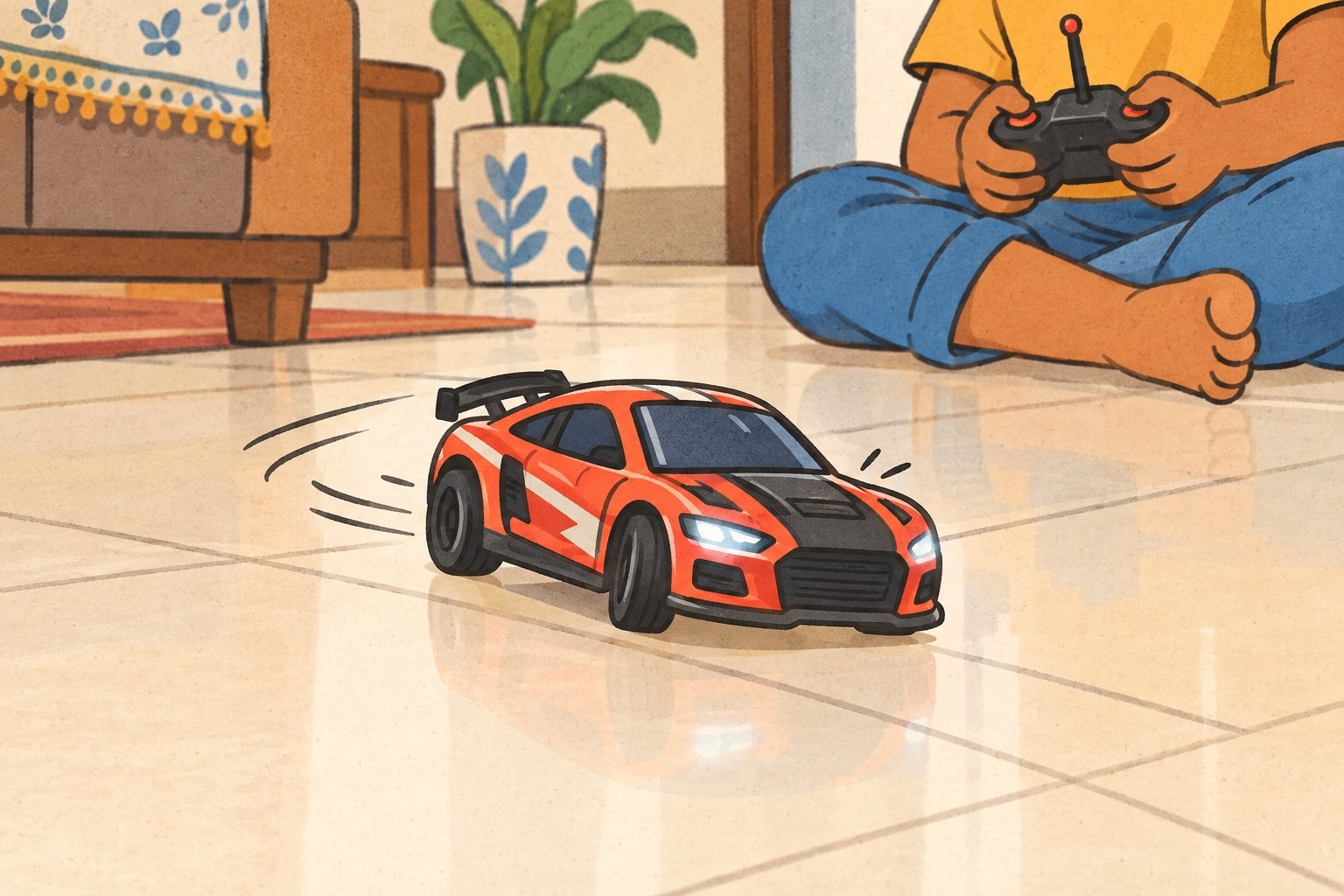
Remote Control Cars for Kids: How to Pick One by Age
Age is the whole decision with RC cars. What works at 3, at 6 and at 9, the five things that decide whether it survives, and honest prices in rupees.

Remote control cars are one of the few toys almost every child asks for at some point, and one of the easiest to get wrong. The failure is nearly always the same: the car is too fast, too fragile or too fiddly for the age it was bought for, and it is in a cupboard within a fortnight with a snapped axle.
Age is the whole decision here. Get that right and almost any decent car works. Get it wrong and the best car on the market is a waste of money.
Match the car to the age, not the price
Ages 3–5: it must survive being driven into a wall
A three-year-old cannot steer. That is not a criticism, it is just where their motor control is. They will hold the control down and drive the car directly into the nearest solid object, repeatedly, and find it hilarious.
So the car needs to be slow, light and blunt. Look for a simple two-button or single-stick remote, a car that is wider than it is tall so it does not flip constantly, and no delicate spoilers or mirrors to snap off. Proportional steering — where turning the wheel a little turns the car a little — is wasted at this age and adds cost.
Something like a mini race car with an easy-grip remote is the right shape of thing: built for small hands, forgiving about crashes.
Ages 6–8: this is where RC gets genuinely good
Around six, two things arrive at once — the fine motor control to actually steer, and the patience to get better at it. This is the sweet spot. A child this age will drive the same car for months, set up cushion courses in the hallway, and time herself.
Now proportional control is worth paying for. So is a car with some grip and a bit of speed, because being able to improve is the point. Scale matters less than people think; a well-made 1:43 alloy formula car in a flat is more fun than a big cheap truck that cannot turn.
Ages 9+: they will want control, not features
Older children stop caring about lights and sounds and start caring about how the car handles. App control, adjustable speed modes, a metal chassis they can inspect — these become interesting. A die-cast RC racer with app control gives them something to tinker with rather than just operate.
The five things that actually determine whether it survives
1. Where will it be driven?
Most Indian homes mean smooth tile or stone floors and not much open run. That suits small, nimble cars with rubber or soft plastic tyres. Large off-road trucks with big treaded wheels are built for grass and dirt and mostly skid uselessly indoors. Buy for the floor you have.
2. Battery type, and be honest about it
Rechargeable built-in batteries mean you plug the car in and wait, typically 40–90 minutes for 15–25 minutes of driving. Replaceable AA cells mean you can swap and keep going, but you will buy a lot of cells.
Whichever you choose, know the number before you buy: most RC cars in this price range give 10–25 minutes of running time. A child expecting an afternoon will be disappointed by twenty minutes, and that disappointment is avoidable by saying the number out loud beforehand.
3. Does the remote take batteries too?
An irritatingly common surprise on a birthday morning. Many cars ship charged but the remote needs two AAA cells that are not in the box. Check, and buy them in advance.
4. The 2.4GHz question
If you have more than one RC car in the house, or your child will play with a friend who has one, you want 2.4GHz radio rather than older fixed-frequency control. Two cars on the same old frequency will fight each other. Almost everything current is 2.4GHz, but it is worth a glance at the spec.
5. Spare parts, or accept it is disposable
At the budget end, RC cars are consumables. Nobody sells replacement axles for a ₹800 car. That is fine as long as you know it going in, and price the toy as something that might last a year rather than five. If you want repairability, you are looking at a different category and a different budget.
What to pay in India
| Type | Fair price | What you get |
|---|---|---|
| Simple starter car, ages 3–5 | ₹700–₹1,500 | Two-button control, slow, sturdy |
| Proportional-control car, 6–8 | ₹1,500–₹2,500 | Real steering, better build, decent speed |
| App or hobby-grade, 9+ | ₹2,000–₹5,000 | Metal parts, speed modes, tinkering |
Below ₹700 you are usually buying a pull-back car with a remote glued to the story. It will not steer and it will not last.
Three mistakes worth avoiding
Buying up an age band because “she’ll grow into it”. She will not. She will crash it, break it, and lose interest before the skill arrives. RC is the one category where buying young is better than buying ahead.
Buying on speed. Speed is the headline number and it is almost never the problem. A car that is too fast for the space is just a car that hits the wall sooner.
Ignoring the noise. Some RC cars are genuinely loud on tile. If your child plays while someone else is working or a baby is sleeping, this becomes the reason the toy gets confiscated. Softer tyres are quieter.
Is it actually worth buying?
We would say yes, with a caveat. RC cars are not educational in the way a puzzle board is, and anyone selling you one on brain development is stretching. What they genuinely build is hand-eye coordination, spatial judgement and — the underrated one — persistence, because a child who wants to get around the table leg without hitting it will try forty times.
That is a real thing for a toy to do. Just buy it for that, at the right age, and check the battery number first.
Our full range is in RC cars, and if you are choosing a gift more broadly, our age-wise gift guide covers the rest.