Don't miss our holiday offer - up to 50% OFF!
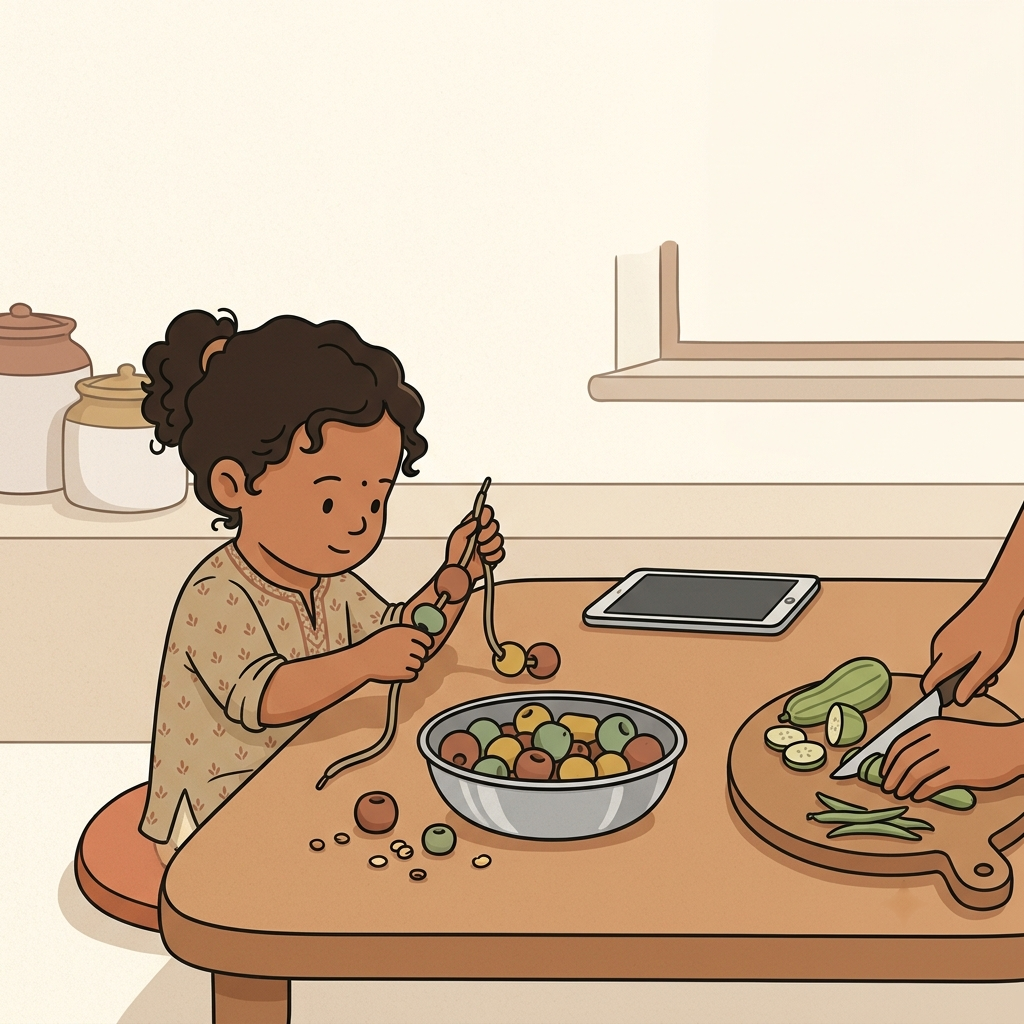
Screen-Free Activities for a 2–4 Year Old: 20 Things to Do at Home
Twenty things that hold a two, three or four year old for long enough to get through the evening without a tablet — most of them using what is already in your kitchen.

There is a particular hour in most Indian homes — somewhere between four and six in the evening — when the child is awake, the adults are tired, and the tablet is the path of least resistance. Nobody plans for it. It just arrives.
This is not a list about willpower. It is a list of things that actually hold a two, three or four year old’s attention for long enough that nobody needs a screen to get through the evening. Most of them use what is already in your kitchen.
Seven things using what you already own
- Rice or dal in a big steel thali. Add two katoris and a spoon. A toddler will pour, scoop and transfer for twenty minutes. Put an old bedsheet underneath and the clean-up is one shake on the balcony.
- The pulses-and-tongs game. Rajma into an ice tray, one bean per compartment, using kitchen tongs. This is fine motor practice dressed up as a game, and children who can just about manage it will do it again and again.
- Washing the vegetables. Give them a bowl of water, a brush and the potatoes. It is genuinely useful, which children can tell, and they take it seriously.
- Sticking tape on the floor. Masking tape roads for cars, or a hopscotch grid, or a line to walk along heel-to-toe. Costs nothing, lasts a week.
- The mystery bag. Five familiar objects in a cloth bag. They put a hand in and guess by touch before pulling it out. Toddlers find this thrilling far longer than it deserves.
- Posting. Cut a slot in a shoebox lid. Give them old bottle caps, or cut-up straws. The urge to put small things into holes is enormous at this age.
- Stacking the dabbas. Every Indian kitchen has a tower of steel containers. Let them build it, knock it down, build it again.
Six things one good toy can carry
The point of buying a toy at all is that it should still work on the fortieth day, not just the first. These are the ones that do.
- Sorting by colour, then by shape, then by size. A wooden shapes and colours board is really three different games depending on which rule you announce.
- Naming the letters, not spelling. With an A–Z puzzle board, a three year old is not learning to read. They are learning that shapes have names, which is the step before it.
- Counting things that are not numbers. Put the number tiles from a 0–9 number board next to that many almonds. The abstraction lands much faster when it is attached to something edible.
- Building taller than yourself. An 87-piece block set on the floor, with the only rule being that it has to stand up on its own.
- Making something that moves. Magnetic sticks and balls that rotate at the joints turn into wobbly creatures, which is more interesting to a four year old than a neat cube.
- Faces. A colour-matching face puzzle where the aim is to build the silliest expression, not the correct one. Rule-free play is still play.
Four things you do together
- Cooking one real step. Tearing coriander, mashing a banana, pressing the atta. One step, done properly, beats a whole pretend kitchen.
- Telling a story with three objects. They pick three things from the room. You make up a story that includes all three. Then they do it back to you, badly, which is the fun part.
- The walk with a job. A ten minute walk downstairs where the job is to find five red things, or three round things.
- Drawing on the same page. You draw a line, they add to it, you add to that. It removes the pressure of the blank page.
Three things for when you need twenty minutes
Being honest: sometimes you need the child occupied and you cannot be in the room. These are the ones that survive that.
- Water and a paintbrush on the balcony floor. They paint, it dries, they paint again.
- A bucket of warm water and the squeeze bath toys. Supervise from the doorway, but you can make a phone call.
- Sticker sheets. Cheap, endlessly absorbing, and the peeling is half the appeal.
What to expect, roughly, by age
Two year olds will stay with something for five to ten minutes and then want you. That is normal and not a sign the activity failed. Three year olds start to play alongside a sibling rather than only next to one. Four year olds will invent rules, argue about them, and change them mid-game — which is exactly what you want, because it means the play belongs to them and not to the toy.
One honest note about screens
None of this is an argument that screens are poison. It is an argument that a screen is the only activity on the list that gives nothing back — a child pours dal and the dal responds, builds a tower and the tower falls, and every one of those is a small experiment. A video plays the same whether or not anyone is watching. If you want the evidence rather than the argument, we went through what the current screen time guidelines actually say separately.
If you want somewhere to start, pick by age rather than by category: toys for 1–3 year olds, 2–4 year olds or 3–6 year olds. A toy that arrives two years too early gets played with once.