Don't miss our holiday offer - up to 50% OFF!
Sensory Play at Home: A Simple Guide for Ages 1–4
Sensory play is not just mess. It is the loop of acting on the world and getting a response — with kitchen setups, two senses most lists leave out, and three safety points.

Sensory play has become a phrase that mostly means mess. It is worth reclaiming, because the actual idea is simple and useful: a very young child builds their understanding of the world by acting on it and noticing what happens back. Pour, and it flows. Squeeze, and it squeaks. Drop, and it lands.
That loop — do something, get a response — is how a one year old learns cause and effect. Everything below is a way of running that loop more often.
There are more than five senses, and two of them explain a lot
Most lists stop at sight, sound, touch, taste and smell. Two more matter enormously for toddlers:
- Proprioception — the sense of where your own limbs are and how hard they are pushing. This is why toddlers press, squash, carry heavy things and crash into sofas. They are calibrating.
- Vestibular — balance and head position. Spinning, swinging, rocking, hanging upside down off the edge of the bed.
A child who seems unable to sit still is very often looking for one of these two. Ten minutes of carrying, pushing and spinning before you need them to be calm works far better than asking them to be calm.
Setups you can build from the kitchen
Touch
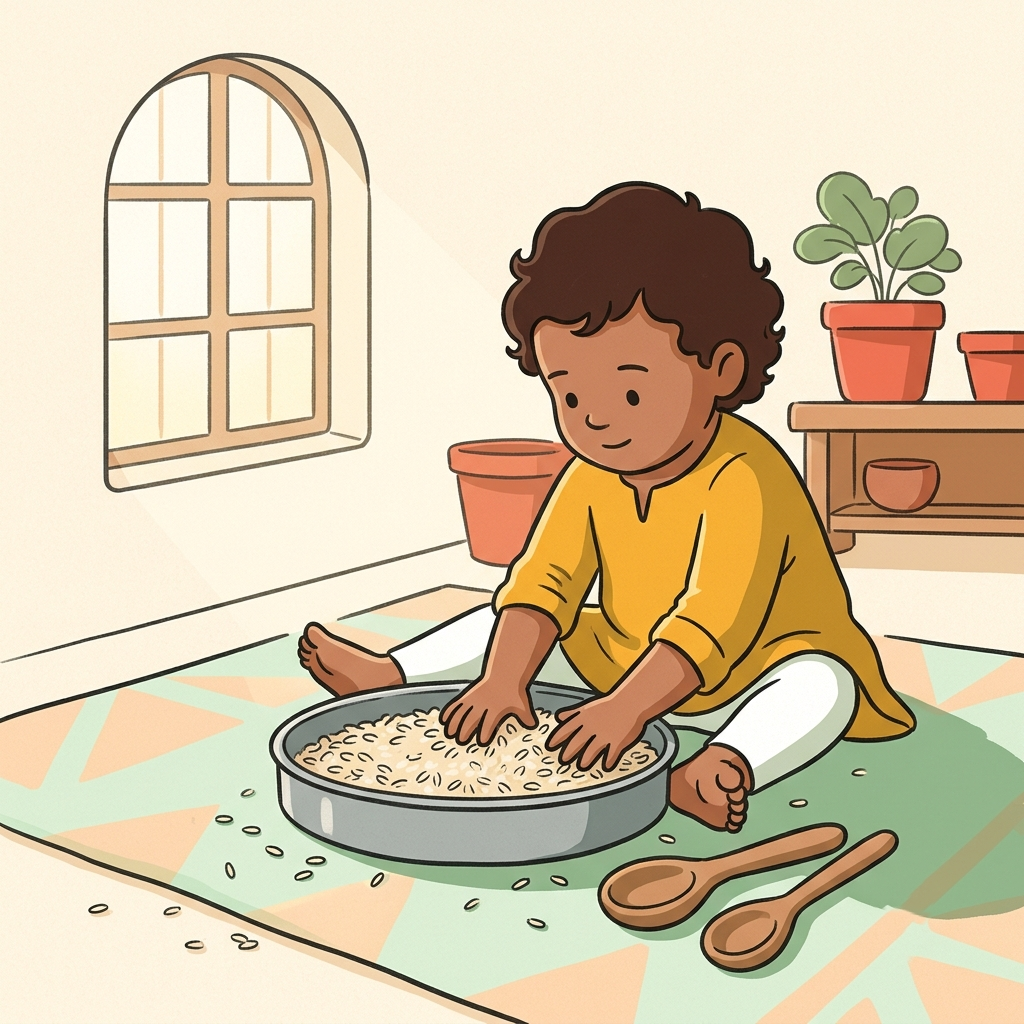
A tray of dry rajma, or wet cooked rice, or atta with a little oil in it. Add spoons and small katoris. The rule that makes it survivable is one tray, on one sheet, in one place.
Sound
Fill three small bottles with different things — rice, coins, a few chana — and seal them properly. A one year old will shake them and compare for a surprisingly long time. A rattle and teether set does the same job with textures added, and is made to go in the mouth, which the bottles are not.
Water
Warm water, two mugs, a sieve and a sponge. Water play is the most reliable calming activity there is for this age group. Squeeze bath toys add a squirt-and-refill loop that toddlers find endlessly satisfying.
Movement
A cushion path to walk along. A bedsheet on the floor to drag a sibling on. Carrying the vegetable bag from the door to the kitchen. All of it is proprioceptive work, and all of it looks like helping.
When a toy is worth buying for this
The test is whether it responds. A toy that moves, lights, sounds or changes when the child acts on it is doing the useful thing. A toy that performs on its own while the child watches is not.
Toys that pass, roughly in age order: a six-piece rattle and teether set from around three months, where every piece has a different surface. A pull-rope hopping rabbit from around one, where the child pulls and the toy moves — the cause is theirs. From around two, the interactive toys that react to touch or motion, which reward chasing and reaching.
The one to be sceptical of is the toy that runs a three-minute song cycle regardless of what the child does. It is not sensory play; it is a small television.
Three safety points, briefly
- Anything that fits through a toilet-roll tube is a choking risk for a child under three. That includes most dry pulses, so rice and dal trays need you in the room.
- Check the battery compartment has a screw on any light-up or musical toy. Button cells are the single most dangerous thing in a toy box.
- Look for the BIS mark and an age band on the box. Toy safety certification has been mandatory in India for several years now; the age band on a compliant toy is a safety statement, not a marketing one. Our guide to what to check on the box covers this in full.
What to expect at each age
Around one: everything goes in the mouth, because the mouth is the most sensitive instrument they own. Choose accordingly. Around two: pouring, filling, emptying, and enormous resistance to being told the activity is finished. Around three to four: sensory play becomes pretend play — the rice is now rice, being cooked, for a doll. That is the point at which it starts to look like a game rather than an experiment.
Most of what fits this age sits in sensory and interactive toys and toys for 1–3 year olds.