Don't miss our holiday offer - up to 50% OFF!
Baby Sensory Toys: What Actually Helps in the First 18 Months
Month by month, what a baby is actually working on and which toys help — plus the four safety checks that matter and the things you can safely skip.

“Sensory toy” has become one of those phrases that means everything and therefore nothing. Put it on a listing and the price goes up twenty percent. Almost anything qualifies — it has a texture, it makes a noise, it is a sensory toy.
Underneath the marketing there is something real. In the first eighteen months a baby is doing one enormous job: working out that she has a body, that it is separate from the world, and that she can make things happen. Nearly everything useful you can buy her is in service of that. Here is what actually helps, month by month, and what you can skip.
0–3 months: contrast and sound, nothing else
A newborn’s vision is poor and short-range. She can focus at roughly 20–30 cm — about the distance to your face when you hold her — and she sees high contrast far better than colour. This is why black-and-white cards work and a beautiful pastel mobile does not.
What helps: your face, high-contrast patterns, and soft sound. What does not: anything she is meant to hold. She cannot grip yet, and a rattle placed in a newborn’s hand is for the adult’s benefit.
Honestly, at this stage you do not need to buy much. Anyone telling you a two-month-old needs a developmental toy kit is selling something.
3–6 months: the hand discovers the mouth
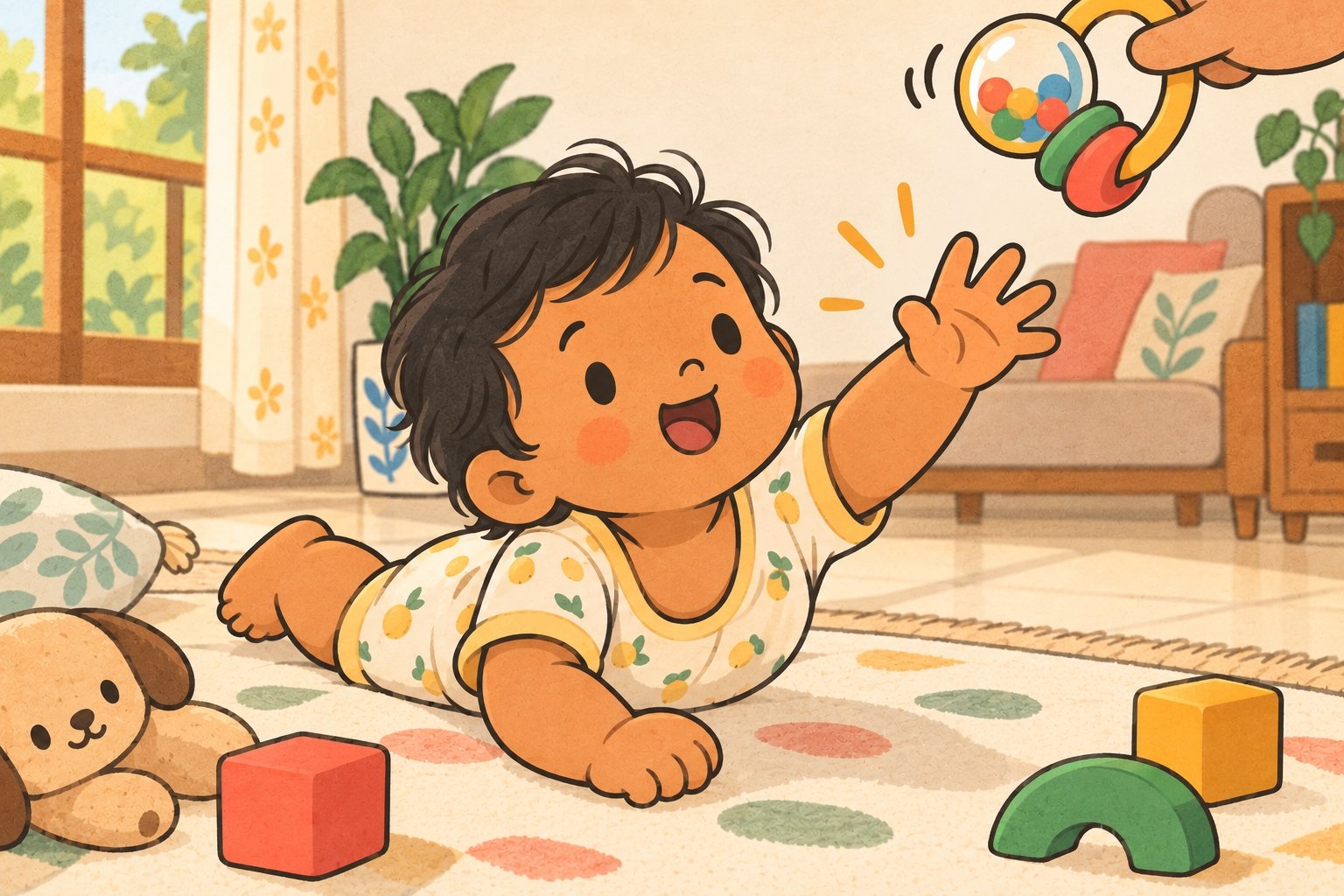
This is when it gets interesting. Around three to four months a baby starts reaching deliberately, and everything she reaches goes straight to her mouth — not because she is hungry, but because the mouth has far more nerve endings than the hand. She is examining it with the best instrument she has.
So the useful toy here is graspable, light, and safe to chew. A rattle and teether set is genuinely the right purchase at this age, and it is one of the cheapest things you will buy.
Three things to check: the handle must be narrow enough for a small fist to close around, the whole thing must be light enough that dropping it on her own face does not hurt, and it must have no seam that can trap skin. Weight matters more than parents expect — a heavy wooden rattle is a bad rattle at four months.
6–9 months: cause and effect arrives
Somewhere around six months a baby works out the single most important idea of her first year: I did that. Press the thing, the thing makes a noise. She will repeat it two hundred times, and every repetition is her confirming the rule holds.
This is the one moment where a light-up, noise-making toy earns its place. It is not lazy parenting — cause and effect is precisely what she is working on, and a toy that responds reliably is teaching it. Something that lights up, changes colour or moves when touched is doing real work here.
What to look for: the response must be immediate and consistent. A toy with a half-second delay, or one that sometimes responds and sometimes does not, teaches the opposite lesson. Also check the volume — many baby toys are startlingly loud, and there is no reason a toy for a six-month-old should be.
9–18 months: movement is the sensory toy
Once she is crawling, the best sensory input available is the floor. Texture under the palms, the effort of pulling herself forward, the discovery that the world has a behind-things. Nothing you buy will beat that.
What toys are for at this stage is giving her a reason to move. A toy that crawls away from her — something like a bump-and-go crawling toy — turns a static object into a chase, and the chase is the point. She is not learning about crabs. She is practising crawling for twenty minutes without noticing she is practising.
Also worth it around a year: anything that goes in and comes out. Stacking cups, a box with a lid, shapes into holes. Object permanence and the idea of containment land around here, and children this age will empty and refill a container until an adult loses patience.
The safety checks that actually matter
The toilet-roll test. If it fits through a toilet-roll tube, it is a choking risk under three. This is the standard and it is worth doing physically rather than trusting a label.
Pull the small parts. Eyes, beads, ribbons, battery covers. Tug each one hard. Battery compartments on baby toys should need a screwdriver to open — if a lid pops off with a thumbnail, do not buy it.
Smell it. A strong chemical smell out of the box means solvent still outgassing. It should not be there on something designed to be chewed.
Check the noise. Hold it at your own ear and press the button. If it makes you flinch, it is too loud for a baby who will hold it much closer.
BIS marking covers most of this — small parts, coating safety, sharp edges — and on a baby toy it is worth prioritising. Our BIS guide explains what the mark does and does not tell you.
What you can safely skip
Sensory kits. A box of twelve textured items at ₹2,500 is almost always four useful things and eight pieces of packaging. Buy the four.
Anything claiming to boost IQ or brain development. No toy has been shown to do this and the claim is a reliable marker of a company that is guessing.
Screens marketed as sensory. A tablet app with bright colours is not sensory play. Sensory means the hands, the mouth, the whole body. A screen engages one sense in the least demanding way available.
Most of what you buy before six months. Genuinely. The useful window starts when the hands do.
What to spend
| Stage | What to buy | Fair price |
|---|---|---|
| 0–3 months | High-contrast cards, soft sound | ₹200–₹500 |
| 3–6 months | Rattle and teether set | ₹300–₹600 |
| 6–9 months | One good cause-and-effect toy | ₹500–₹1,000 |
| 9–18 months | A moving toy, stacking cups | ₹600–₹1,200 |
The whole first eighteen months can be covered well for under ₹3,000. Anyone quoting you five figures for a developmental programme is selling reassurance, not equipment.
The short version
Before three months, buy almost nothing. From three to six, buy something light she can grip and chew. From six to nine, one reliable cause-and-effect toy. From nine onwards, buy things that make her move and things she can fill and empty. Check the small parts, check the volume, and ignore anything promising brain development.
What we stock for this age sits in sensory and interactive toys, and if you want the play side rather than the shopping side, our sensory play at home guide covers what to do with none of it.