Don't miss our holiday offer - up to 50% OFF!
Homeschooling in India: Why More Families Are Choosing Home Learning
Why homeschooling is growing in India, how it works (NIOS and other routes), and how toys and books fit into a home learning day.

Ten years ago, if you told your relatives you were thinking of teaching your child at home, you’d have got a worried silence. Today more Indian families are asking the question, and it is no longer unusual in cities like Mumbai, Pune, Bengaluru, Delhi and Chennai. Online classes during the pandemic opened many parents’ eyes to what learning at home looks like, and many have kept some of it ever since.
This guide looks at why families are choosing home learning, how it works in India, and how toys and books fit into a home learning day. It isn’t legal advice, and it isn’t a recommendation for or against homeschooling, because the right answer depends on each family.
The short answer
Homeschooling in India means a parent-led education outside a regular school. It is not clearly regulated: the Right to Education Act does not specifically describe it, and families usually follow a flexible curriculum or an open-school route such as NIOS. Families who choose it mention flexible pace, personal attention and a stronger parent connection. It takes a lot of parent time, so it isn’t for everyone. Many more families do something lighter, which is to add structured learning at home next to school.
Why more families are considering it
- Personal pace. A child can spend a week on fractions or race ahead on stories, instead of keeping to a class timetable.
- Flexibility. Learning can happen in the morning, on a trip or in the kitchen. Families who travel or have shift-based work find this useful.
- Children who struggle in a big class. Some children need smaller groups, a quieter place or a different way of learning.
- Parents who want more involvement. Many parents want to know what their child is learning and why.
- Online resources. Courses, videos and printable material are now far easier to find than before.
How it works in India
News reports and homeschooling guides describe a few common routes. Some families follow their own flexible syllabus built around the child’s interests. Others use the National Institute of Open Schooling (NIOS), which offers open schooling levels and secondary and senior secondary courses that are recognised for further study. Some use an international curriculum online, and some register as private candidates for board exams. Fees vary a lot, from a small amount for self-guided learning to a much bigger amount for a full online programme.
The legal position is something every family should check for themselves. Reports describe homeschooling as lawful and say the Right to Education Act does not forbid it, but also note there is no single regulator for homeschoolers, and local authorities can have different expectations. Ask a local homeschooling group or an education lawyer before you decide.
What a home learning day can look like
It rarely looks like school at home. A typical day for a young child might include:
- A short block of reading together, plus a few pages of a workbook.
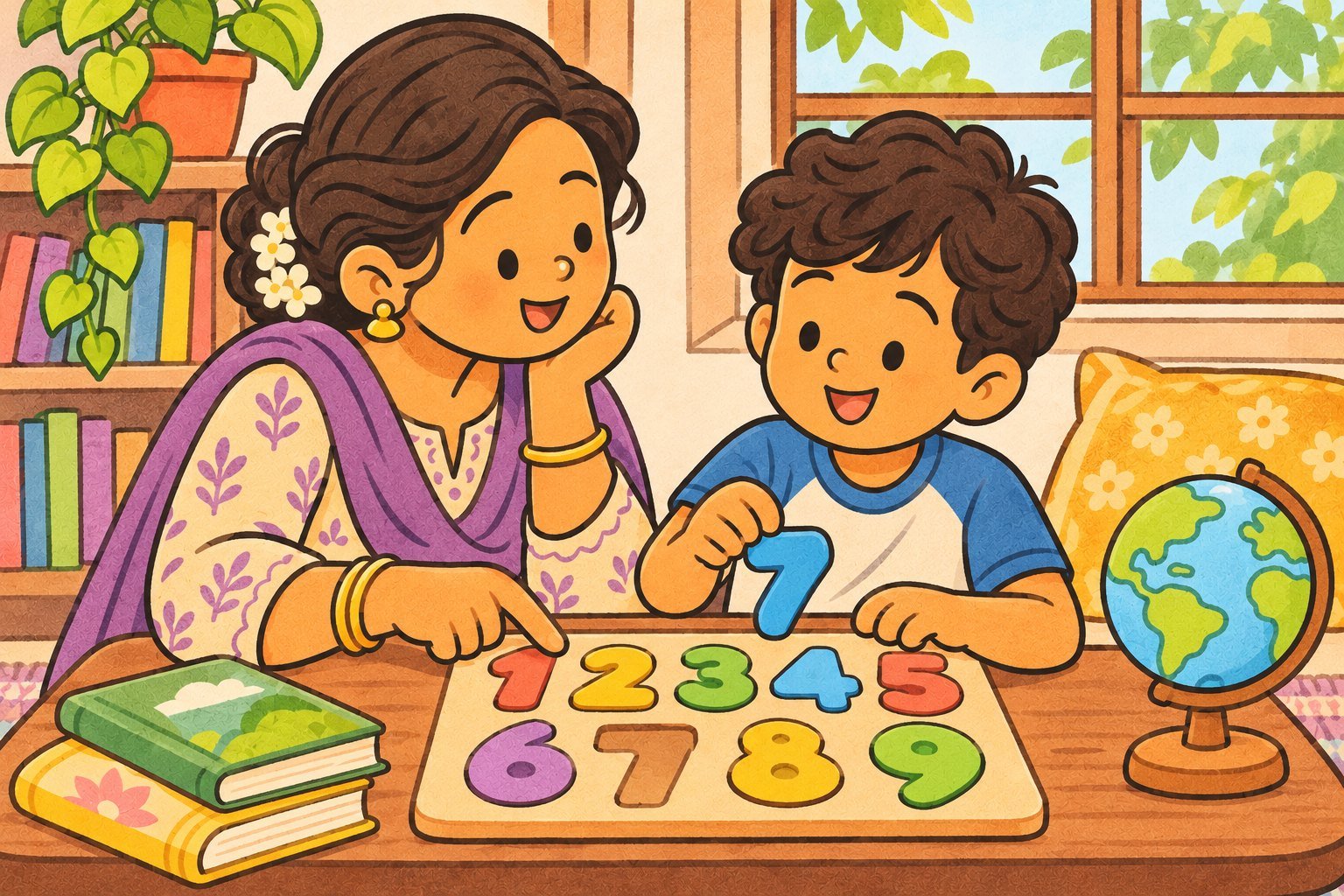
- Hands-on maths with objects: counting blocks, sorting, a number puzzle.
- Something creative: drawing, clay, building.
- Movement and outdoor time.
- Free play, which is learning too.
The role of toys and books
When learning happens at home, the materials in your house become the classroom. A few well-chosen toys do a lot of the work.
- Numbers and letters: wooden puzzle boards let a child touch and place numerals and letters. Our numbers 1 to 20 board, alphabet board and shapes and colours board are each ₹189.
- Reading: sound books turn early phonics into something a child can press and hear. See our interactive phonetic sound book (₹449).
- Science and engineering: magnetic building sticks and blocks teach shape, balance and structure. Browse our building toys.
- Writing practice without paper: a reusable writing tablet is useful for a child learning to form letters.
For the thinking behind this, read our guide on how interactive toys support brain development and the age-by-age list of educational toys for kids in India.
Things to think about honestly
- Time. Someone has to be available, and that often means one parent working less.
- Social life. Children need other children. Plan regular meetups, sports or classes.
- Exams and pathways. Decide early which board or open-school route you will use, so you aren’t surprised later.
- Your own energy. It is a long-term commitment, and it is fine to try it for a year and review.
You don’t have to choose all or nothing
Most families who start thinking about home learning end up with a middle path: school as usual, plus a structured hour at home for reading, maths games and play. That alone can make a child more curious. If that sounds like you, start with one or two good learning toys and read together every day. Every Tukoy order also donates 2% to children’s charities.