Don't miss our holiday offer - up to 50% OFF!
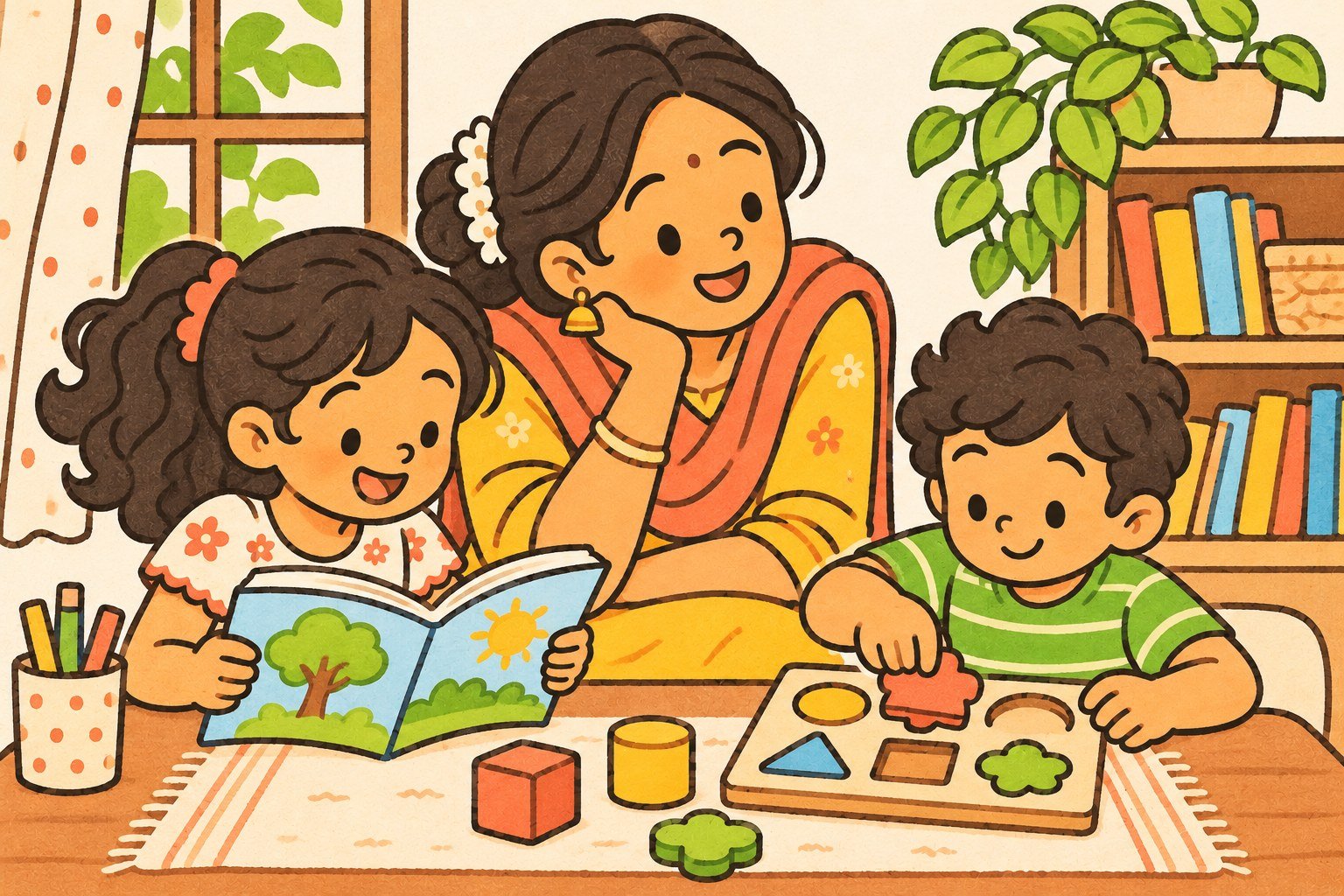
Benefits of Homeschooling in India: 10 Real Advantages (and the Honest Trade-offs)
The real benefits of homeschooling in India — personalised pace, deeper learning, family time, less stress — plus the honest trade-offs to weigh before you decide.

Homeschooling used to be something Indian families whispered about. Now it’s a real conversation in living rooms across Mumbai, Pune, Bengaluru, Delhi, Hyderabad and smaller cities too. Some parents come to it because school isn’t working for their child. Others choose it from the start because they want a different kind of childhood.
We’ve written about why Indian families choose home learning. This post goes deeper into the specific benefits — and, because no choice is perfect, the trade-offs you should weigh honestly.
1. Learning at your child’s own pace
In a class of forty, the syllabus moves at one speed. At home, a child who grasps multiplication in a week can move on; a child who needs a month can take a month — without being labelled “slow”. This is probably the single biggest benefit of homeschooling: the learning fits the child instead of the other way round.
2. Understanding instead of memorising
Without the pressure to reproduce textbook answers for a test, families can focus on whether a child actually understands. You can spend a whole morning on why boats float — building, testing, failing, trying again — instead of memorising a definition of buoyancy.
3. Following the child’s interests
Homeschooling lets you build learning around what excites your child. A child who loves cars can learn physics through ramps, maths through speed and distance, and reading through car books. Interest-led learning tends to go deeper and stick longer.
4. More time for play, especially in the early years
For children under eight, play is the main engine of learning. Homeschooled young children usually get far more time for hands-on, open-ended play: building, puzzles, pretend play, art and outdoor exploration. Simple tools like a wooden numbers board (4–6 years on the box) or a 54-piece tumbling tower (6–9 years) turn maths and motor skills into games.
5. Less stress and comparison
No ranks, no public comparison, no fear of the teacher’s red pen. Many parents notice their child becomes calmer and more willing to try difficult things once the fear of judgement is gone.
6. A flexible schedule
Learning doesn’t have to happen from 8 a.m. to 2 p.m. Some children think best in the morning, others in the afternoon. Homeschooling families can travel off-season, visit grandparents for weeks, or take a museum day midweek when it’s quiet.
7. Stronger family relationships
Spending more time together — learning, cooking, reading, solving problems — often brings families closer. Siblings learn to teach and help each other. Parents get to know how their child actually thinks.
8. Learning from real life
Homeschooling makes it easy to learn from the world: the market, the kitchen, the railway station, the garden, a visit to a farm or a workshop. Real-life learning builds practical skills that many school leavers lack, from handling money to talking to adults with confidence.
9. Space for children who don’t fit the mould
Children who are gifted, neurodivergent, very sensitive, or dealing with health issues often struggle in a one-size-fits-all classroom. Homeschooling can give them the pace, environment and attention they need. (Always work with qualified professionals where a child needs specialist support.)
10. Values and character, by design
Parents get to shape the culture of learning at home — kindness, honesty, responsibility, curiosity — and model it every day, rather than leaving it mostly to peer groups.
The honest trade-offs
Homeschooling is not right for every family, and it would be unfair to list only the upside.
- It takes a lot of parent time. Usually one parent reduces or changes their work. For young children, a few focused hours a day is enough, but someone has to be present and engaged.
- Socialisation needs planning. Children don’t automatically get friends their age. Families typically join homeschool groups, co-ops, sports, music and activity classes to build social circles.
- The legal position is not fully settled. Homeschooling is not banned in India, but the Right to Education Act was written around formal schools, and there is no single national framework for homeschoolers. Check with local homeschooling networks, and consider a recognised route such as NIOS for formal certification later.
- Certification needs planning. At some point, most children will need a recognised certificate for higher studies. Options include NIOS and international private-candidate exams. We cover these in homeschool curriculum options in India.
- Relatives may not understand. Expect questions. A calm, clear explanation — and a happy, curious child — usually answers them over time.
- Parent burnout is real. Plan breaks, share teaching between adults where possible, and lean on community.
Is it right for your family?
Ask yourselves a few questions:
- Is our child unhappy or not learning in school — or are we choosing this proactively?
- Can one adult realistically commit time each day?
- Do we have, or can we build, a community of other families?
- Are we comfortable with some uncertainty and figuring things out as we go?
If the answers point to yes, the next step is practical. Read our step-by-step guide on how to start homeschooling in India.
The bottom line
The benefits of homeschooling are real: a pace that fits your child, deeper understanding, more play, less fear and closer family bonds. The costs are real too: time, planning and some uncertainty. Many families find the trade worth it. Whatever you decide, the lessons behind homeschooling — curiosity, play, patience — can improve learning in any home.