Don't miss our holiday offer - up to 50% OFF!
How to Start Homeschooling in India: A Step-by-Step Guide for Parents
A practical, step-by-step guide to starting homeschooling in India — legal basics, choosing an approach, setting up a learning space, routines, certification and community.

You’ve read about the benefits of homeschooling, talked it over as a family, and you’re ready to try. Now what? This guide walks you through the practical steps of starting homeschooling in India, from the legal basics to your first week.
Note: we’re a toy shop, not lawyers. Rules and programmes change, so always confirm current details with the official bodies and local homeschooling networks mentioned below.
Step 1: Get clear on your “why”
Write down why you’re homeschooling. Is your child unhappy at school? Do you want more time for play and real-world learning? A slower or faster pace? Your reasons will guide every later choice — and give you something to come back to on hard days.
Step 2: Understand the legal basics
Homeschooling is not banned in India, but the legal picture has grey areas:
- The Right to Education Act, 2009 makes elementary education free and compulsory for children aged 6–14, and it was written with formal schools in mind.
- When this was challenged in the Delhi High Court around 2011–2013, the central government stated that the RTE Act does not rule out homeschooling or alternative education. There is still no single national framework for homeschoolers.
- For children under 6, there are no compulsory schooling requirements.
- For certification, the National Institute of Open Schooling (NIOS) — a national board under the Ministry of Education — is the most common route used by homeschoolers.
Practical advice: keep simple records of what your child learns (a notebook, photos, work samples), connect with local homeschooling groups who know how things work in your state, and plan your certification route early.
Step 3: If your child is in school, plan the exit
Inform the school in writing, collect your child’s records and any transfer certificate, and keep copies. Expect some questions; a polite, brief explanation is enough.
Many families also take a “deschooling” break of a few weeks — no formal lessons, lots of reading, play, outings and rest. It helps children (and parents) shift out of school mode and rediscover curiosity.
Step 4: Choose an approach
There’s no single way to homeschool. Common approaches include:
- Structured / school-at-home: following a set curriculum and timetable, often aligned with NCERT or a chosen board.
- Montessori-inspired: child-led work with hands-on materials, practical life skills and a prepared environment. (See what counts as a Montessori toy.)
- Charlotte Mason: “living books”, nature study, narration and short lessons.
- Unschooling: learning driven almost entirely by the child’s interests and daily life.
- Eclectic: mixing whatever works — the most common choice in practice.
You don’t have to decide forever. Many families start structured and relax, or start relaxed and add structure as children grow. We compare formal options in homeschool curriculum options in India.
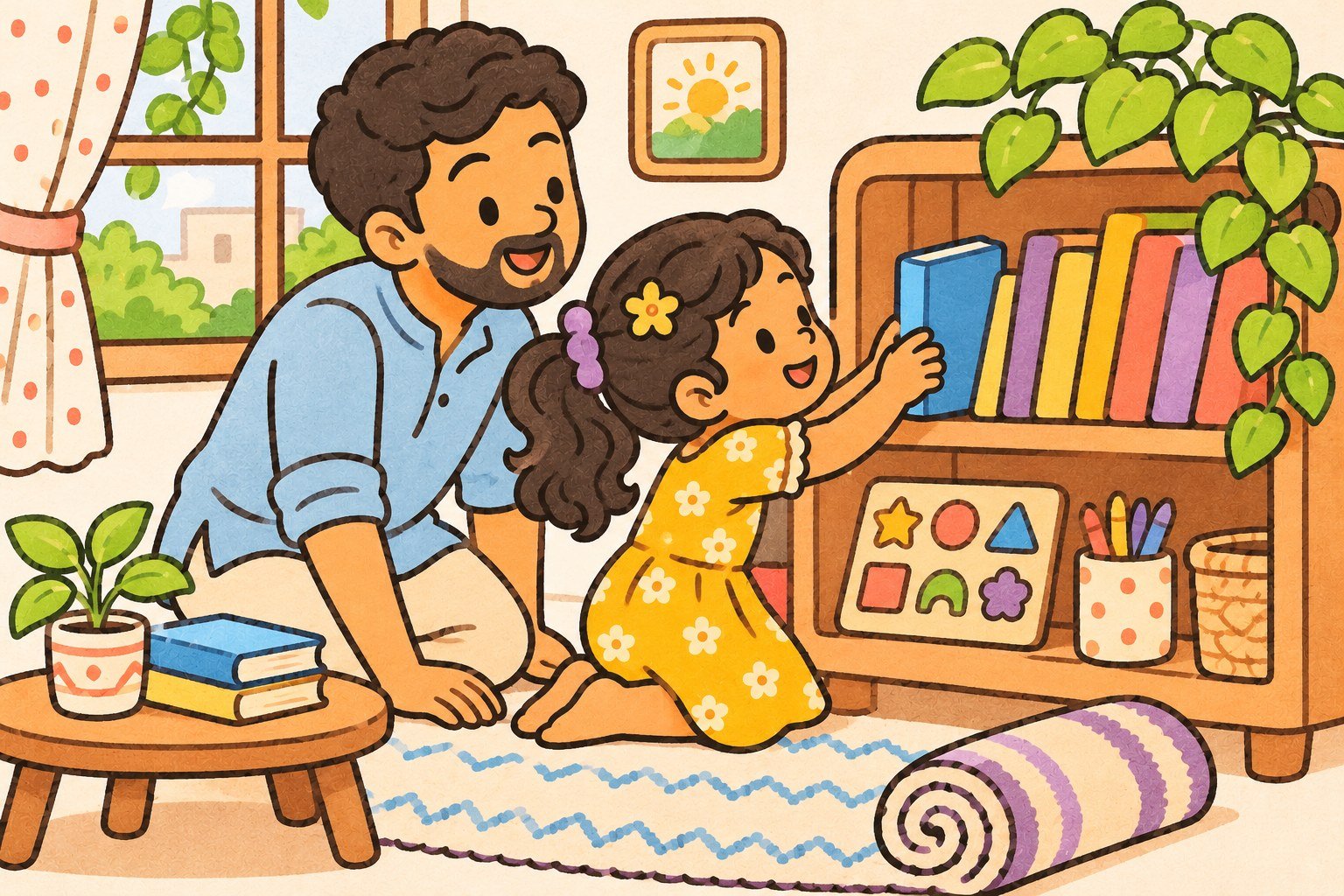
Step 5: Set up a simple learning space
You don’t need a classroom. A corner with a low table, good light, a bookshelf and a few storage boxes is plenty. Useful basics:
- Books — picture books, early readers, reference books, library membership if possible.
- Art supplies — paper, crayons, paints, scissors, glue.
- Hands-on maths and literacy tools — counting objects, number and letter puzzles like our wooden 0–9 numbers board (2–4 years on the box) and A–Z alphabet board (2–4 years).
- Building and STEM toys — blocks or magnetic sticks (3+) for spatial reasoning and engineering play.
- A wall calendar or chart for routines.
Rotate materials every couple of weeks so things feel fresh, rather than buying everything at once.
Step 6: Build a gentle routine
Young children don’t need six hours of lessons. For ages 3–6, one to two hours of focused learning spread across the day is plenty, with lots of play in between. For ages 6–9, two to three hours is typical. Anchor the day with predictable rhythms — reading after breakfast, outdoor time after lunch — rather than a rigid clock. We share a sample in a simple homeschool daily routine.
Step 7: Plan certification for later
Young children don’t need exams, but it helps to know where you’re heading:
- NIOS Open Basic Education (OBE): levels A, B and C, equivalent to Classes 3, 5 and 8, run through accredited agencies. Check current eligibility rules for your child’s age with NIOS.
- NIOS Secondary and Senior Secondary: equivalent to Class 10 and 12, widely recognised for higher education.
- International private-candidate exams such as Cambridge IGCSE, taken at approved exam centres — usually much more expensive.
Step 8: Find your community
This is the step families most often regret skipping. Look for city homeschooling groups, WhatsApp communities, co-ops, park meet-ups and activity classes. Community solves the socialisation question, gives children friends, and gives parents support and ideas.
Step 9: Track progress — lightly
Keep a simple learning log: books read, projects done, skills practised, photos of work. It reassures you, helps with any future certification, and is lovely to look back on.
Step 10: Review and adjust every few months
Ask: Is my child happy? Learning? Curious? Is this sustainable for us? Change what isn’t working. Flexibility is homeschooling’s superpower.
Your first week: a simple plan
- Day 1: Visit a library or bookshop; let your child choose books.
- Day 2: Kitchen maths — measuring, counting, halving a recipe.
- Day 3: Nature walk — collect leaves, sort them, draw them.
- Day 4: Building challenge — tallest tower, strongest bridge.
- Day 5: Story day — read, act out, then draw or write a new ending.
The bottom line
Starting homeschooling in India is less about having everything figured out and more about taking the first steps with care: understand the legal basics, choose a flexible approach, set up a simple space, keep records, and find your people. Your child’s curiosity will do much of the rest.