Don't miss our holiday offer - up to 50% OFF!
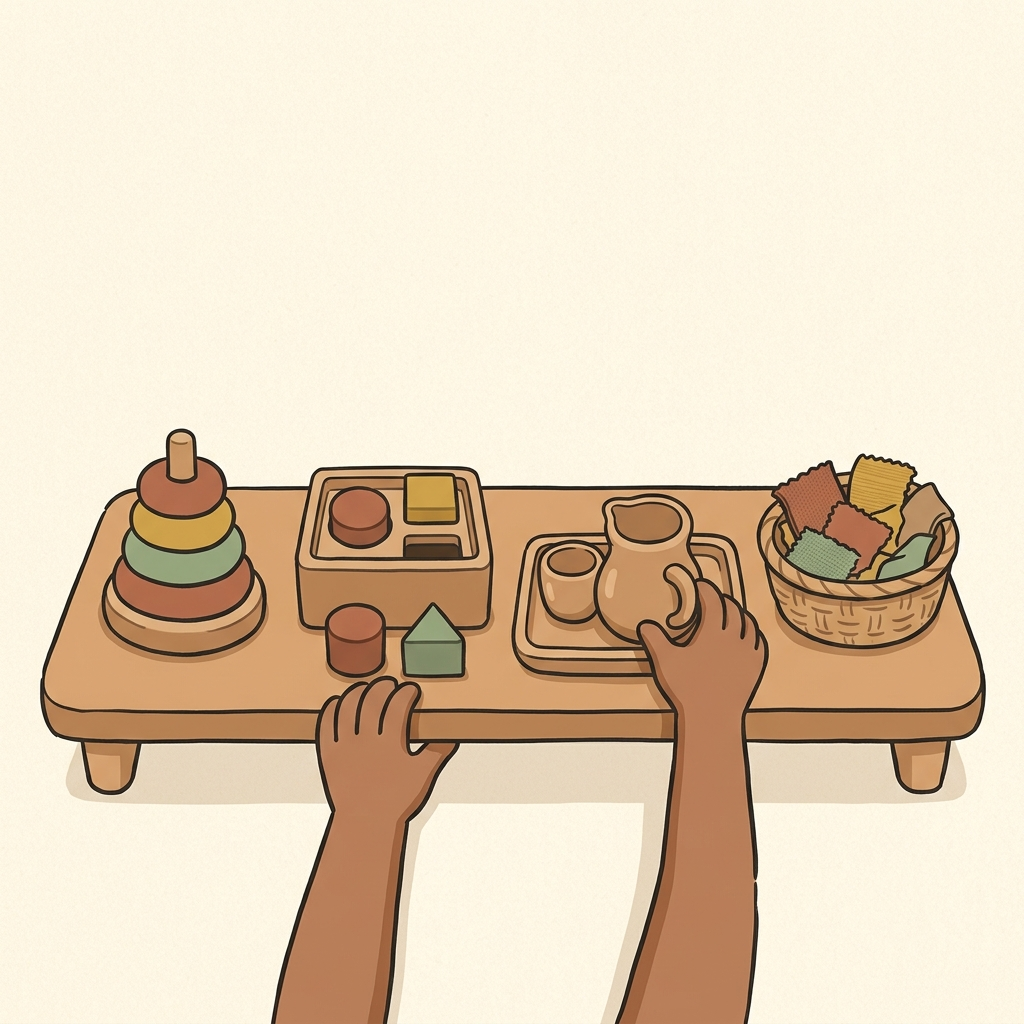
Montessori Toys for Toddlers: What Actually Counts (and What Is Just Marketing)
Montessori is not a trademark, so anyone can print it on a box. Five tests you can apply in ten seconds to tell a real material from a marketing word.

The word Montessori is not a trademark. Anyone can print it on a box, and in the Indian toy market a great many people do. That is the first thing worth knowing before you spend two thousand rupees on something because of a word on the packaging.
Maria Montessori was a physician who spent decades watching what young children actually did with objects. What came out of that is a set of principles about the object itself — not a style, and definitely not a colour palette. Here is what those principles are, and how to apply them in about ten seconds while standing in a shop.
The five tests
1. Does the child do the work, or does the toy?
This is the one that matters most. If the toy sings, flashes and completes the activity while the child watches, the child is an audience. A shape sorter does nothing at all until a hand puts a shape in the right hole. The rule is simple: the more the toy does, the less the child does.
2. Is it self-correcting?
A good material tells the child they were wrong without an adult saying so. The circle does not fit into the square hole. The tower will not balance if the big block goes on top. This is why children repeat these activities so obsessively — they are running an experiment and getting an honest answer every time.
3. Does it do one thing?
Montessori materials isolate a single quality. This set is about size. That one is about colour. The other is about shape. A toy that flashes, sings, teaches letters, plays music and has a steering wheel teaches a child to switch attention rapidly, which is the opposite of what you were hoping for.
4. Is it real, and does it feel like something?
Wood, metal and cloth have weight, temperature and grain. Moulded plastic has none of these, and a child holding it learns less about the physical world. This is not snobbery about plastic — it is that a heavier object gives more feedback to a small hand.
5. Is it the right size for the child, not for the shelf?
Materials should be usable by the child without asking. A tray they can carry. A board they can lift. If an adult has to set it up every time, it will be used far less often than you imagined when you bought it.
What gets sold as Montessori and mostly is not
- Anything battery-operated described as Montessori. The two ideas are in direct conflict.
- Muted colours as a substitute for design. Beige is not a principle. Montessori materials are often brightly coloured, because colour is one of the qualities being isolated.
- Busy boards with twenty activities on one panel. This is the opposite of isolating a skill.
- Anything that requires an adult to run it. If it only works as a lesson, it is a lesson, not a material.
What passes, and roughly when
Around one to two: posting, transferring and fitting. A shapes and colours board is close to a textbook example — sixteen pieces, self-correcting, one quality at a time, and the child can carry it themselves.
Around two to four: matching symbol to name. An alphabet board works here not because a three year old is learning to read but because letters are shapes with names, and the board lets them handle the shape.
Around four to six: quantity becoming number. A 0–9 number board, or the 1–20 version, is most useful when the tiles sit next to that many real objects. The symbol is abstract; the almonds are not.
Around four upwards: open-ended construction. An 87-piece block set is not strictly a Montessori material, but it satisfies every test above — the child does all the work, gravity does the correcting, and there is no right answer to reach.
An honest note, since we sell toys
We also sell toys that light up and move, and they do not pass the tests on this page. That is fine, because they are for something else: a nine month old learning that their own action causes a result, or a toddler who needs to be delighted rather than educated for ten minutes. Both are legitimate. The mistake is buying one and believing you bought the other. For a broader view that is not tied to one method, we have an age-wise guide to educational toys in India.
If you want the shelf that comes closest to these principles, it is the wooden toys, and you can filter the whole catalogue by age from 1–3 upwards.