Don't miss our holiday offer - up to 50% OFF!
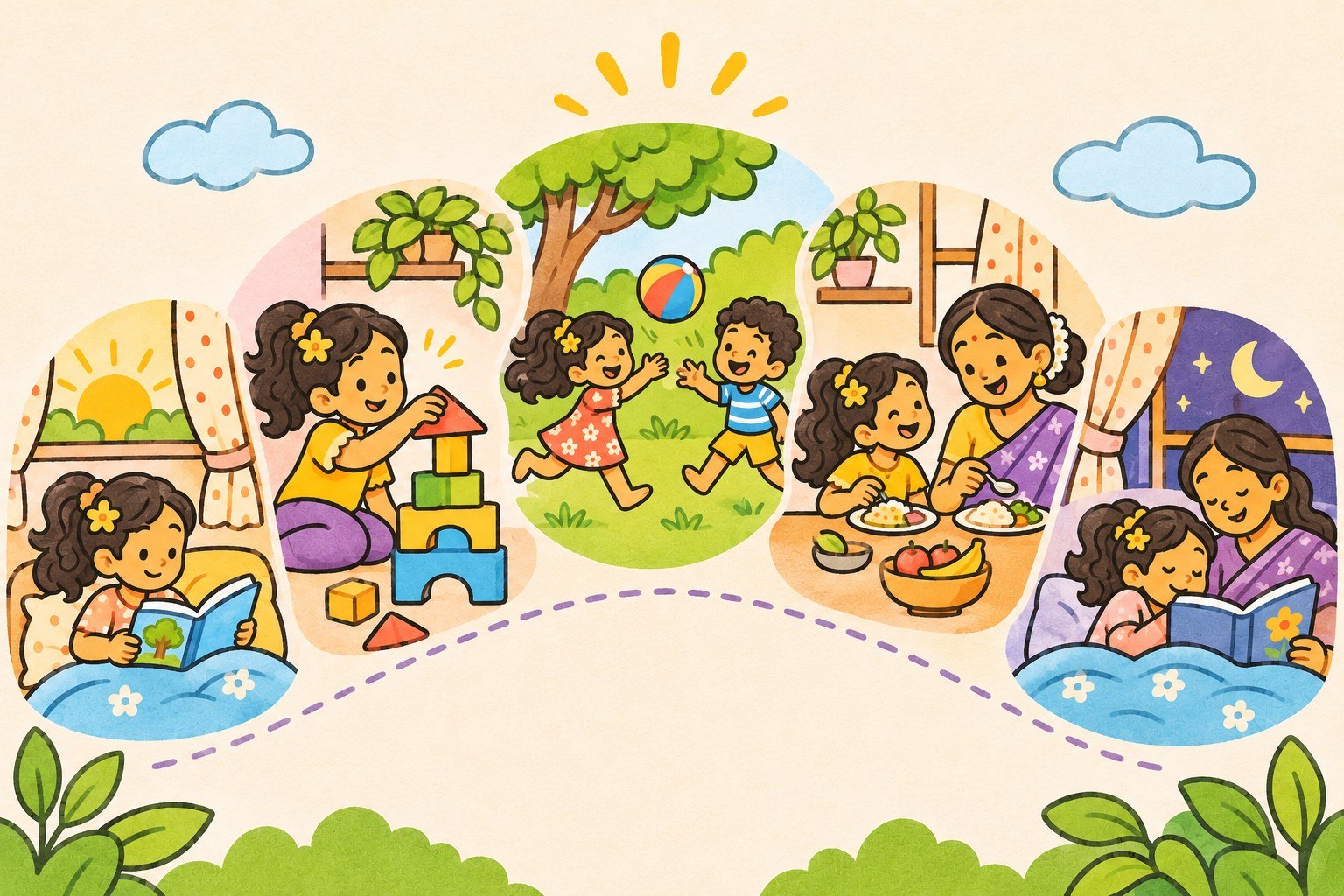
A Simple Homeschool Daily Routine for Ages 3–8 (With Sample Timetables)
A realistic homeschool daily routine for young children in India, with sample timetables for ages 3–5 and 6–8, plus tips to keep the day calm, playful and flexible.

One of the biggest surprises for new homeschooling parents is how little time formal learning actually takes with young children. A school day is long partly because one teacher is managing a large class. At home, with one or two children, focused learning goes much faster — and the rest of the day can be filled with play, reading, chores and outdoor time, all of which are learning too.
Here’s a realistic homeschool routine for ages 3–8, with sample timetables you can adapt.
Rhythm, not a rigid timetable
Young children thrive on predictability, but not on a clock that rings every 40 minutes. Think in terms of a daily rhythm: the same sequence of activities each day — breakfast, reading, play, lunch, rest, outdoors — with flexible timings. Children feel secure knowing what comes next, and you don’t feel like a failure when something runs over.
How much focused learning is enough?
- Ages 3–5: about 30–60 minutes of adult-guided activity, in short bursts of 10–15 minutes.
- Ages 6–8: about 1.5–3 hours, in blocks of 20–30 minutes with breaks.
Everything else — free play, conversation, cooking, outdoor time, stories — is still learning. It just doesn’t look like school.
Sample routine: ages 3–5
| Time | Activity |
|---|---|
| 7:30–8:30 | Wake up, breakfast, help with simple tasks (setting the table, watering plants) |
| 8:30–9:00 | Story time — read aloud together, talk about the pictures |
| 9:00–9:15 | Focused activity: shapes, letters or numbers with a puzzle board |
| 9:15–10:30 | Free play — blocks, pretend play, art |
| 10:30–11:00 | Snack and music — songs, rhymes, a toy xylophone |
| 11:00–12:00 | Outdoor play or a walk — collect leaves, spot colours |
| 12:00–1:00 | Lunch, wind down |
| 1:00–2:30 | Nap or quiet time with picture books |
| 2:30–3:00 | Hands-on activity: sorting, pouring, playdough, simple craft |
| 3:00–5:00 | Play, visit the park, meet friends |
| Evening | Family time, bath, bedtime story |
Useful tools for this age: a wooden shapes & colours board (1–3 years on the box), an alphabet puzzle board (2–4 years), and a small xylophone (3+) for music time.
Sample routine: ages 6–8
| Time | Activity |
|---|---|
| 7:30–8:30 | Wake up, breakfast, morning chores |
| 8:30–9:00 | Reading — independent reading or read-aloud |
| 9:00–9:30 | Maths — hands-on first, then a few written problems |
| 9:30–10:00 | Break — movement, snack |
| 10:00–10:30 | Writing or language — journal, letters to grandparents, spelling games |
| 10:30–11:30 | Project time — science experiment, building challenge, EVS topic |
| 11:30–12:30 | Outdoor play or sport |
| 12:30–1:30 | Lunch and rest |
| 1:30–2:00 | Second language practice or music |
| 2:00–4:00 | Free play, hobbies, art, board games |
| 4:00–6:00 | Activity classes, park, friends |
| Evening | Family dinner, conversation, reading before bed |
For project time, open-ended STEM toys are worth their weight: magnetic sticks (3+) for geometry and structures, building blocks (4–6 years) for engineering challenges, and a tumbling tower (6–9 years) for physics, balance and turn-taking.
A weekly rhythm adds variety
Give each weekday a light theme to keep things fresh without extra planning:
- Monday: Library or bookshop day
- Tuesday: Kitchen science and cooking
- Wednesday: Nature and outdoor exploration
- Thursday: Art and music
- Friday: Outing — museum, market, farm, workshop, or meet-up with homeschool friends
Tips to keep the day calm
- Do the hardest thing early, when attention is fresh.
- Alternate sitting and moving. Every focused block should be followed by movement.
- Keep screens out of learning time for young children, and keep them limited overall. See our screen-free activities for ideas.
- Use chores as learning. Folding laundry is sorting and matching. Shopping is maths and reading labels.
- Let boredom happen. A few bored minutes often turn into the most creative play of the day.
- Have a “low-energy day” plan — audiobooks, puzzles, baking — for days when you or your child are tired or unwell.
- Rotate toys and materials every week or two instead of putting everything out.
What if my child won’t cooperate?
It’s normal, especially early on. Shorten the focused block, offer choices (“letters with the puzzle or with chalk outside?”), follow their interest, and try again later. Connection comes before instruction. A child who feels heard learns far better than one who feels pushed.
The bottom line
A good homeschool routine for young children is short on formal lessons and long on play, reading, conversation and outdoor time. Build a predictable rhythm, keep focused learning brief, and let everyday life do the rest. Adjust as your child grows — the routine should serve your family, not the other way round.
Just starting? Read how to start homeschooling in India.